2G REBCO Tape Architecture
Understanding the micrometer-scale multilayer nanostructure that enables zero-resistance current above liquid nitrogen temperature (77 K).
REBCO vs Legacy Superconductors
REBCO (Rare-Earth Barium Copper Oxide) is the only commercially scalable High-Temperature Superconductor combining a 92 K critical temperature with high in-field critical current performance at liquid nitrogen temperatures.
Operating Envelope Comparison
Reel-to-Reel Thin-Film Deposition
Zero Resistance Superconductors manufactures 2nd Generation Coated Conductor (2G-HTS) tape using atomic-scale epitaxial deposition onto high-tensile flexible metal substrates.
Unlike brittle 1G BSCCO wire, 2G REBCO tape exhibits remarkable mechanical resilience — carrying up to 800 Amps per cm-width under intense Lorentz magnetic forces while bending to a 10mm radius without Ic degradation.

Click Any Layer to Inspect Specs
The active REBCO superconducting layer is only 1–5 μm thick — yet it is the workhorse of the entire tape stack, supported by structural, thermal, and crystallographic buffer layers.
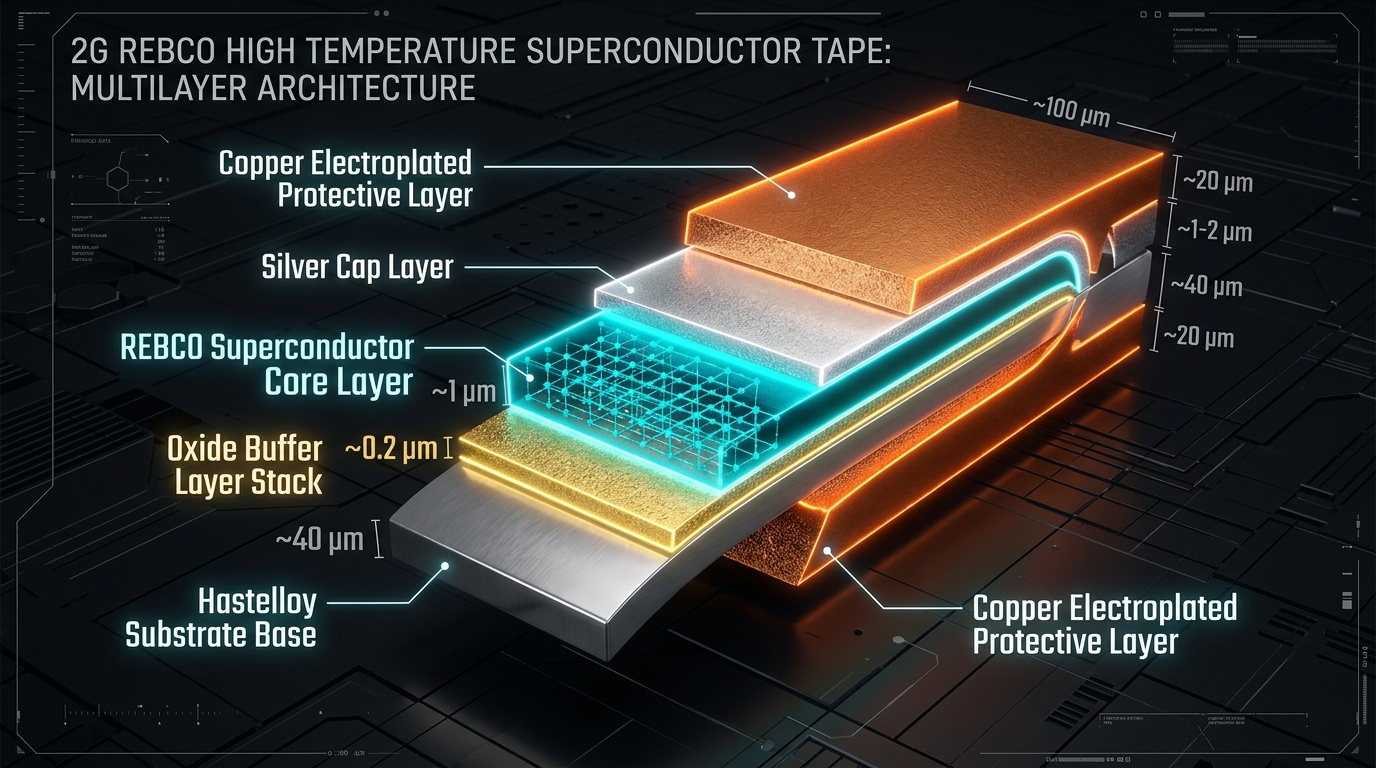
Silver (Ag) Protective Layer (~1–2 μm)
Provides a low-resistance electrical shunt and chemically stabilizes the underlying superconducting REBCO oxide layer against environmental degradation and thermal over-temperature quench events.
- Thickness: 1 to 2 micrometers
- Function: Thermal shunt & electrical bypass protection
4 Core REBCO Deposition Methodologies
High-vacuum thin-film synthesis techniques for continuous kilometer-scale tape production.
Thin-Film Deposition Process Comparison (PLD, MOCVD, MOD, RCE)
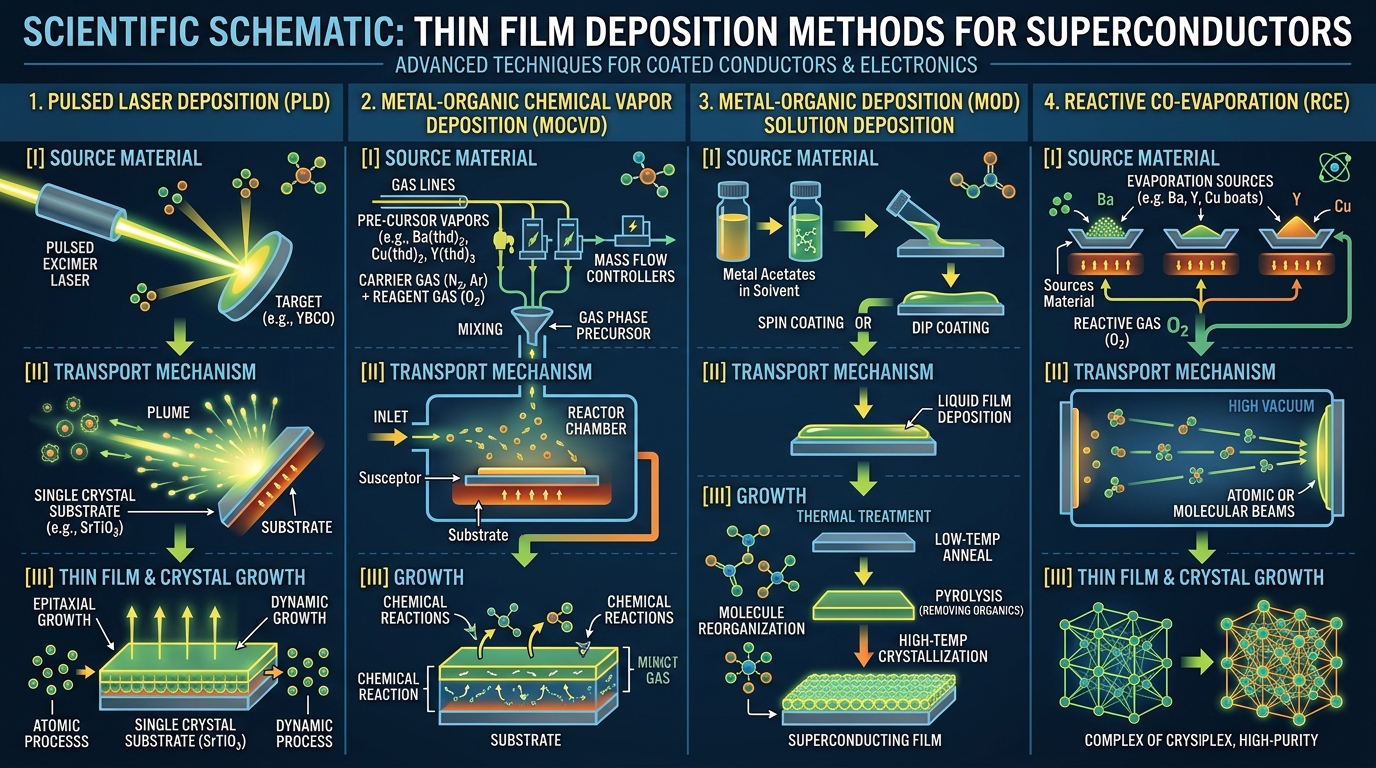
Pulsed Laser Deposition (PLD)
Excimer laser vaporizes stoichiometric REBCO ceramic targets to deposit defect-pinned crystalline films with ultra-high critical current density (Jc) in applied magnetic fields. Used in research and high-performance prototype tapes.
Metal-Organic CVD (MOCVD)
Decomposes metal-organic precursor gases onto heated flexible metal tape substrates, enabling continuous high-speed reel-to-reel web coating. Currently the leading commercial deposition method for kilometer-scale production.
Metal-Organic Deposition (MOD)
Applies a liquid metal-organic precursor solution followed by controlled thermal decomposition baking. Offers a low-cost, high-yield chemical synthesis route scalable to industrial width formats.
Reactive Co-Evaporation (RCE)
Simultaneously thermal-evaporates rare-earth constituent metals under precise oxygen partial pressure to achieve the fastest deposition rates over wide-format tape substrates for high-throughput production lines.